Mundinger Hug
Introduction of Prof. Dr. Michael Soffel - Universität Dresden
 Years ago, when I met Hug Mundinger for the first time and he showed me some of his paintings, I was initially amazed at the multitude of artistic techniques and manners of presentation he implemented. Hug Mundinger developed many of his own techniques: for example, he does not only work with a paintbrush or palette knife, but also commonly with cans of spray paints or a spray gun. He often treats the painting surface (cardboard, plywood, or canvas) with various materials, such as sand, synthetic materials, paper, etc., in order to create e.g. three dimensional structures. These techniques create a wide spectrum of color tones and atmospheres: ranging from bleak, muddy or sooty pictures to exceedingly colorful and airy images.
New, original, and amazing aspects can be discovered in Mundinger's works. Moreover, many of the artist's paintings show his intense examination and contemplation of the perception, composition, and style of the post-impressionist masters.
This historic and equally essential artistic involvement with the post-impressionist masters - from Degas to Picasso, from Miro to Ernst and Dali - were the impetus for Hug Mundinger to find his own artistic style. Through current themes and adequate techniques and methods, the artist was able to establish a decisive simplification of the creative instruments and their complex interactions. A formal and content-related new determination of the painting's statement thus became possible.

 At first glance, the observer recognizes subjects and figures on the one hand, and abstract geometric forms on the other. Man/Mankind is one of the central themes which Mundinger addresses; abstract, just barely recognizable nudes are commonly found in his works. In his seemingly abstract paintings, the observer is initially struck by the geometric figures such as circles or rectangles. Upon closer inspection we see that these geometric formations are in a complicated environment, thus winning in importance/meaning. A simple and beautiful example of this is the planet paintings, in which we have an almost compelling impression that the central spherical shape is a sun that is being observed from an orbiting planet. At second glance, we begin to recognize additional structures that we associate with a planet: shapes similar to trees or bushes, which might even be reflecting in the water of a lake or ocean.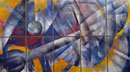
The realization that there is a cosmic reference in all of Hug Mundinger's works deeply moved me. Once the mental eye is trained to recognize this cosmic reference, we recognize many of the forms and structures of our modern scientific view of the world: suns, planets, galaxies, supernovas, and living beings. Not only are the structures in the space of cosmic depth represented, but also temporal aspects of cosmic evolution are expressed in his work. There are paintings that show the birth of our universe in the form of a Big Bang, and others show the life and death of stars, and still more depict the formation of larger structures, such as galaxies. Finally, Mundinger's paintings show the future of the universe, its end and death, which are possibly nothing more than a new beginning of cosmic events.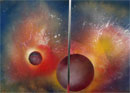
Thus modern art and modern science develop a mutual area of tension. This visionary perceptions of art together with the efforts of science to find concrete, measurable facts creates a fertile symbiosis.
Tübingen, 20.1.1995